
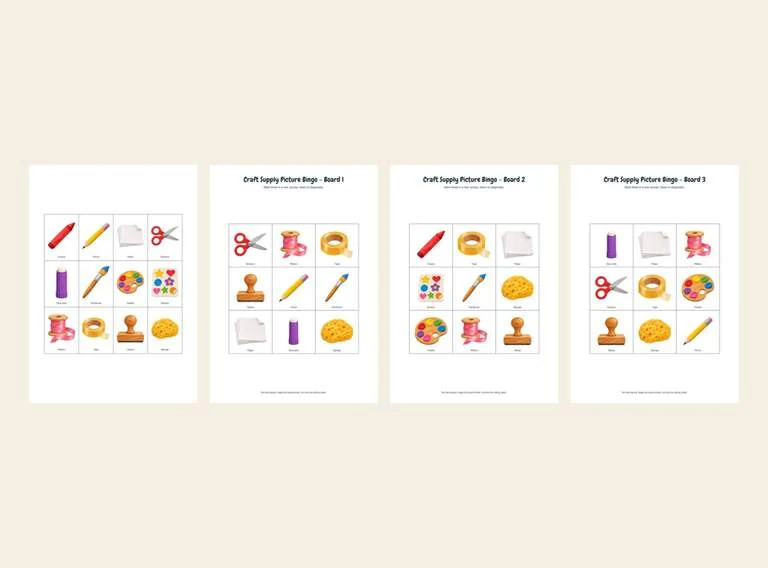
Bring familiar craft-table pictures into a bingo round for two to four players. Four different 3 × 3 boards use twelve colorful supplies, from a red crayon to a yellow sponge. Print the boards and calling cards, then play by matching pictures; no real craft supplies are needed for the game.
Choose Your Download
The complete pack contains 6 pages. Both paper sizes include the same content. Downloads open directly without an email sign-up.
| File | A4 | US Letter |
|---|---|---|
| Complete pack (6 pages) | A4 PDF | Letter PDF |
| Four player boards (4 pages) | A4 PDF | Letter PDF |
| Calling cards (1 page) | A4 PDF | Letter PDF |
| Illustrated guide (1 page) | A4 PDF | Letter PDF |
Prepare the Boards and Calling Cards
Choose the PDF size that matches your paper: A4 or US Letter. Print in portrait orientation at actual size / 100%. The complete six-page pack contains four player boards, one calling-card sheet and one illustrated guide. Use either the complete pack or the separate files below; printing both would duplicate the pages.
Keep all four player boards whole. Cut the calling sheet around its outer edge and along the shared straight grid lines to make twelve 43 × 58 mm cards. Give each of two to four players a different numbered board. Have a pencil ready, or supervise loose paper counters if you prefer reusable boards. No separate counters are included in the PDFs.
Meet the Twelve Pictures
The calling pictures are crayon, pencil, paper, scissors, glue stick, paintbrush, palette, stickers, ribbon, tape, stamp and sponge. A red crayon differs clearly from the yellow pencil with a pink eraser. The purple glue stick stands upright; the ribbon winds around a spool, while the tape is a golden roll with a loose end. Compare those two rolls before play. The stickers have colorful small shapes on one sheet, and the wooden stamp has a rounded handle. Each numbered board uses nine of these twelve pictures in a different arrangement.
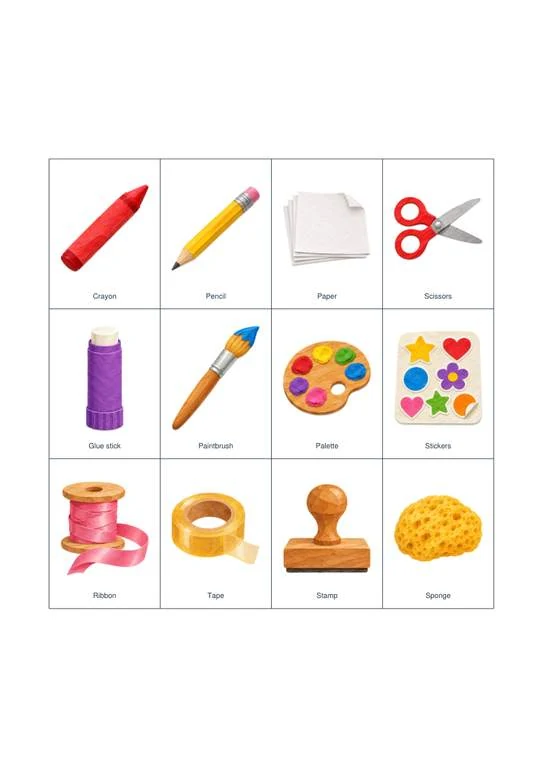
A Closer Look at Board 1
Scissors, ribbon and tape cross the top. Stamp, pencil and paintbrush fill the middle, above paper, glue stick and sponge.
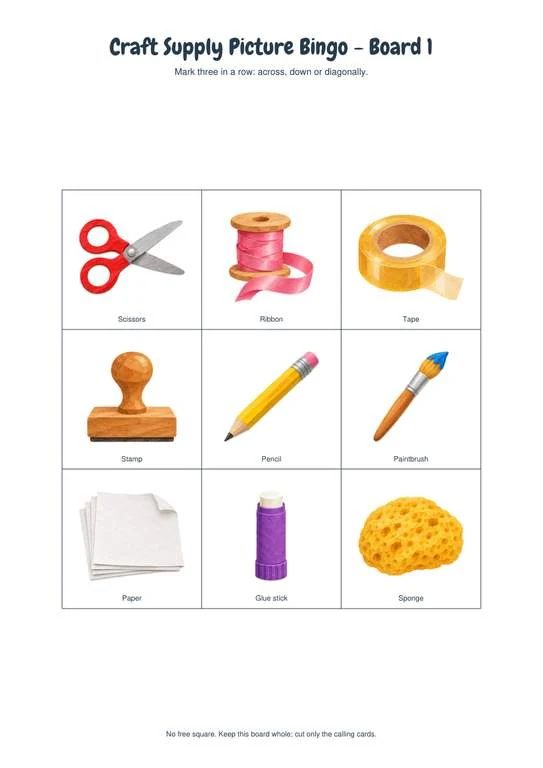
A Closer Look at Board 2
Crayon, tape and paper begin this board. Stickers, paintbrush and sponge make its middle row; palette, ribbon and stamp are underneath.
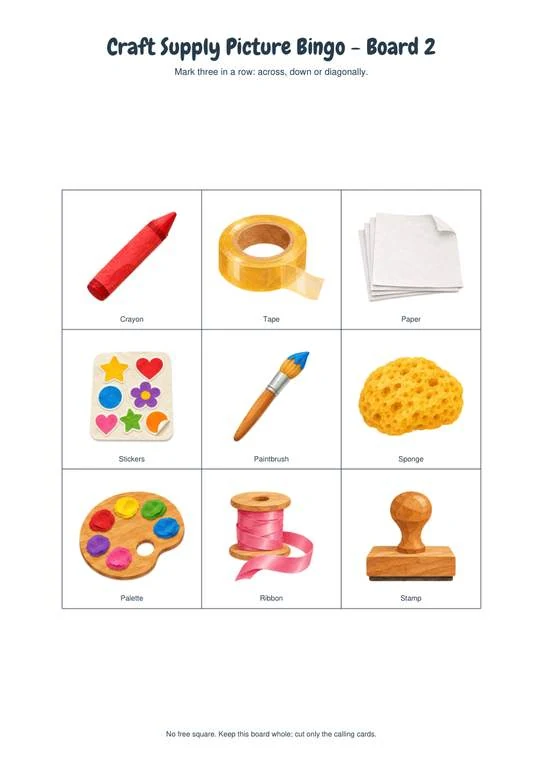
A Closer Look at Board 3
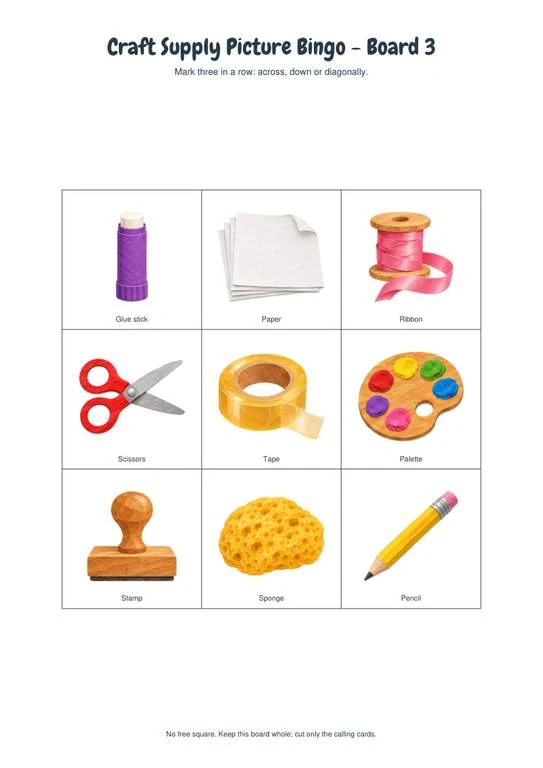
Glue stick, paper and ribbon appear above scissors, tape and palette. Stamp, sponge and pencil finish the bottom row.
A Closer Look at Board 4
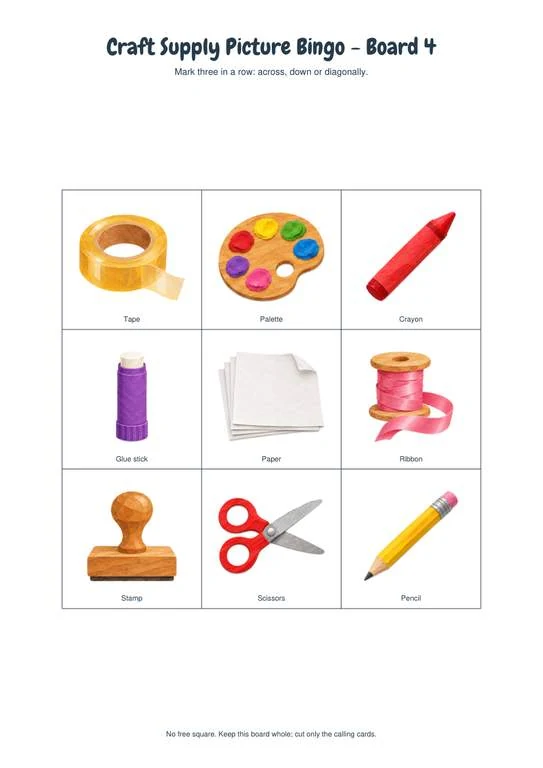
Tape, palette and crayon sit at the top. Glue stick, paper and ribbon cross the middle, above stamp, scissors and pencil.
Call, Mark and Check a Line
Shuffle all twelve calling cards face down. The caller turns over one card, shows the picture and says its name. Players mark that same picture if it appears on their own board. If it is absent, they wait for the next call. Leave called cards face up so everyone can check them.
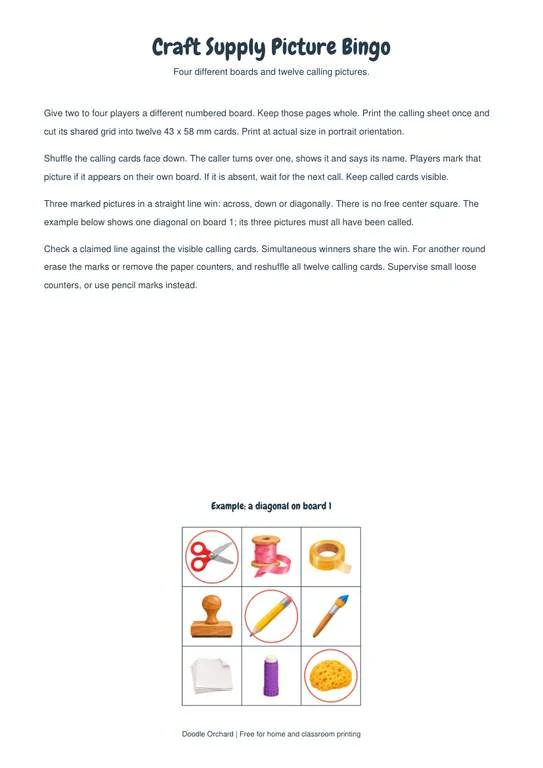
Three marked pictures in a straight line win: horizontally, vertically or diagonally. There is no free middle square. For example, on board 1 the diagonal from top left through the center to bottom right is scissors, pencil and sponge. All three must have been called; a mark in another square does not complete that diagonal. The illustrated guide shows this exact line.
When someone calls bingo, compare each picture in their claimed line with the face-up calling cards. If two players finish on the same call, share the win. For a new round, erase pencil marks or remove counters, gather all twelve calling cards and shuffle again.
Choose a Relaxed First Round
Show a calling picture for as long as the group needs and help match it by shape and details. This keeps the game usable for children who do not read the labels yet. A caller and one player can use a single board for a quiet version; with more players, use the four different boards rather than several copies of the same arrangement.
Store the twelve calling cards with the uncut boards. Before packing away, count the cards so a missing picture does not silently prevent a line in the next game.
You may print these files for personal, family and classroom activities. Share this resource page rather than selling or rehosting the PDFs.