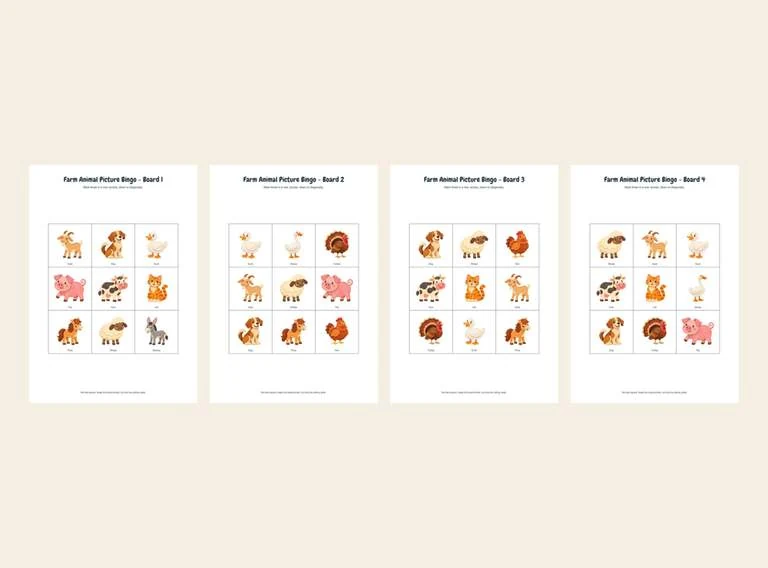
Play farm animal picture bingo with four different printable boards and twelve illustrated calling cards. Each board has nine pictures in a three-by-three grid, with no free square. Players mark a called animal when it appears on their own board; three marked pictures in a straight line win. Print the boards whole and cut only the separate calling sheet.
Choose Your Download
The complete pack contains 6 pages. Both paper sizes include the same content. Downloads open directly without an email sign-up.
| File | A4 | US Letter |
|---|---|---|
| Complete pack (6 pages) | A4 PDF | Letter PDF |
| Four player boards (4 pages) | A4 PDF | Letter PDF |
| Calling cards (1 page) | A4 PDF | Letter PDF |
| Illustrated guide (1 page) | A4 PDF | Letter PDF |
Board 1: Goat, Dog and Duck Across the Top
Boards 1 to 4 use different selections and arrangements from the twelve-animal picture pool: cow, pig, sheep, goat, pony, donkey, hen, duck, goose, turkey, dog and cat. Board 1 starts with goat, dog and duck in its top row. Small names beneath the pictures help identify the intended animal, while players can match the illustration itself.
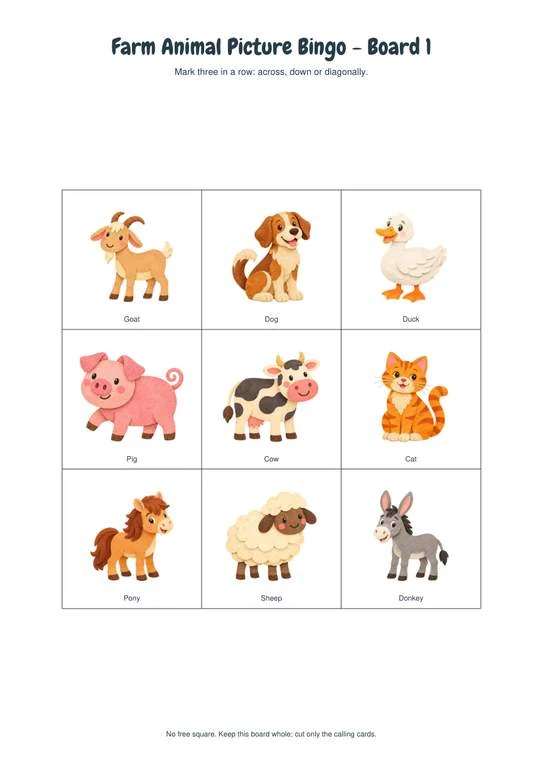
Each board stays on its own page. Its nine 54 mm squares give room to see the pictures and add a small pencil mark. Do not cut the board into cards: the rows and columns are needed for the game.
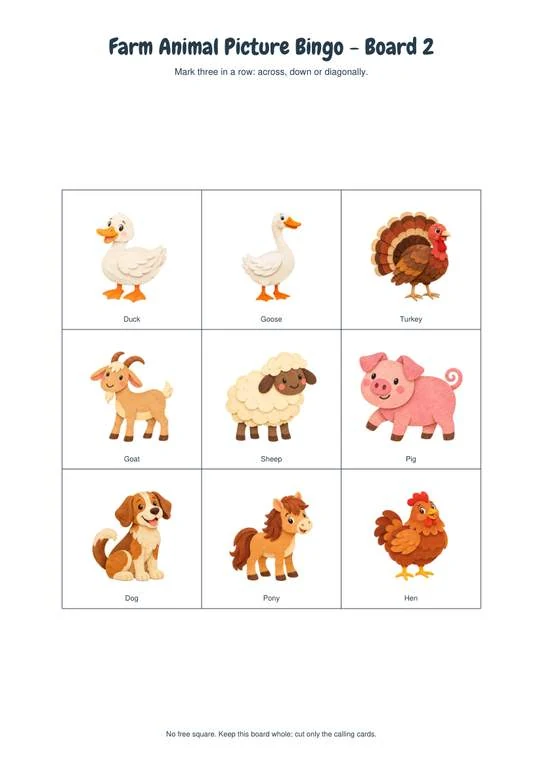
Board 2: Look for the Goose and Turkey
Board 2 begins with duck, goose and turkey across its top row. Its central square is the sheep, rather than board 1's cow. This board includes a hen at the bottom right, but no cow, cat or donkey. Players should check their own grid after each call instead of copying a neighbouring player's marks.
Board 3: A Different Place for the Same Picture
On board 3, dog, sheep and hen form the top row. The cat is in the centre, and the pony is at the bottom right. Pictures that also appear on board 2 occupy different positions, so a call can help both players without completing the same line. The pig, donkey and goose are absent here.
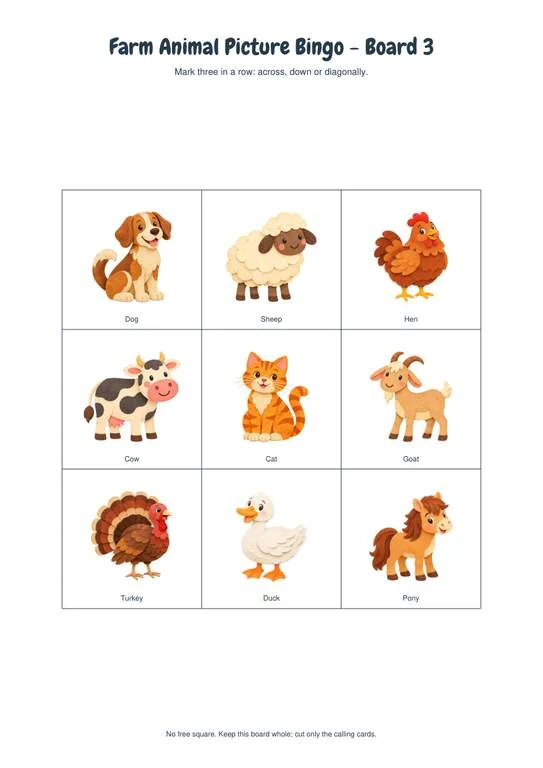
Board 4: Sheep, Goat and Duck
Board 4 has sheep, goat and duck at the top, cow, cat and goose in the middle, and dog, turkey and pig along the bottom. Its centre is the cat. There is no pony, donkey or hen on this board; keep those calls visible for other players without marking an unrelated animal.
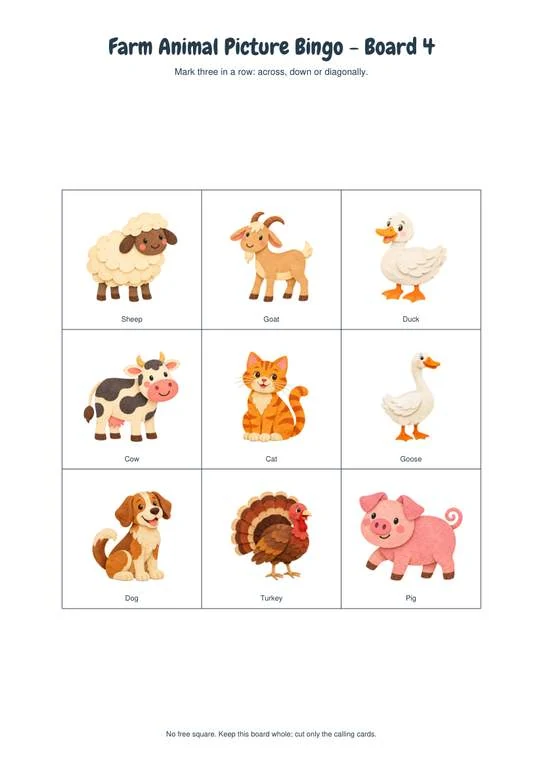
Cut the Twelve Calling Cards
The fifth page is a separate four-by-three block containing one picture of every animal. It has shared straight cutting lines, rather than individually spaced cards with extra decoration to trim away. At actual size, each calling card measures 43 by 58 mm.
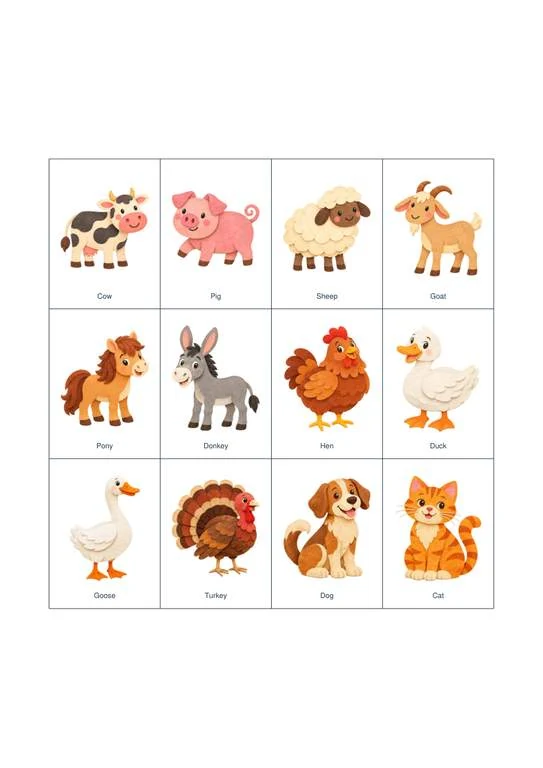
Print this sheet once for a group, even when printing several player boards. Trim the outside rectangle, cut the strips and then separate the twelve cards. Put all twelve in a pile. Each board contains only nine of them, so an animal being absent from one player's board is expected.
Choose Files and Prepare the Table
Select the A4 or US Letter PDFs that match your paper. Both versions contain the same four boards, calling sheet and illustrated rules. Print in portrait orientation at actual size, or 100%. You can download the six-page complete pack or just the boards and calling cards if you do not need printed instructions.
These are filled colour pictures. A colour printer keeps their paper-collage appearance; a black-and-white printer produces grey versions of the same designs. Before printing multiple boards, check that small labels and the full grid are visible. Give two to four players a different numbered board each.
Call, Show and Mark
Shuffle all twelve calling cards face down. Turn one over, show it to everyone and say the animal's name. Players look for that exact picture on their own boards. If they find it, they mark that square. If it is missing, they wait for another call; a board is not supposed to contain all twelve animals.
Keep each called card face up so everyone can check earlier calls. Use light pencil marks, or an erasable cover and suitable marker. If using loose paper counters instead, supervise small pieces around young children. Pictures remain in their original squares throughout the round.
Check a Winning Line
A player wins by marking three squares in one horizontal row, vertical column or diagonal. There is no free centre square. The example on the guide circles a diagonal on board 1: goat, cow and donkey. Those three animals must all have been called before that line is a win.
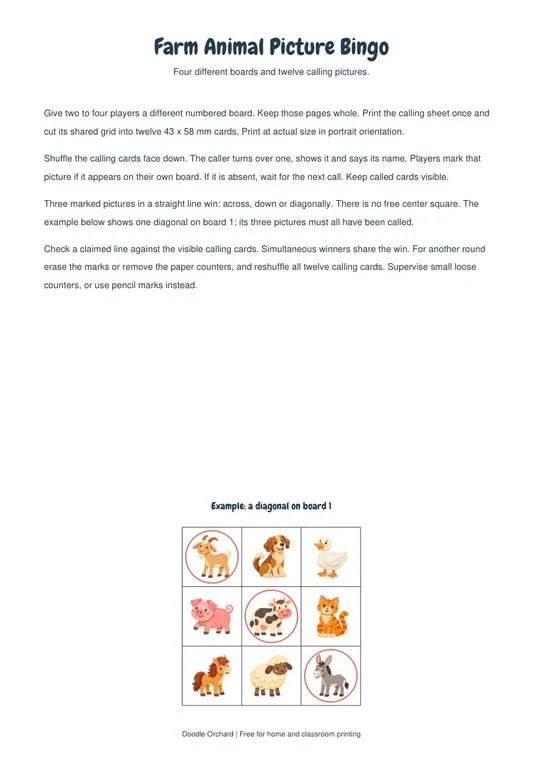
When someone calls bingo, compare all three pictures in the claimed line with the face-up calling cards. A marked square from an animal that has not been called does not count. If the same call completes lines for two players, they share the win rather than using speaking speed to decide.
Reset or Play with Fewer People
For a two-player game, choose any two different boards and use the full twelve-card calling deck. One player can call as well as mark a board, or an adult can take the caller role. The other two boards can stay unprinted; they are options, not a requirement for a complete round.
For another round, clear every mark, return all twelve calling cards to the deck and shuffle them. Players may swap boards before restarting. Store the calling cards together and keep the boards flat. If a card is lost, reprint just the calling sheet instead of the entire pack.
You may print these files for personal, family and classroom activities. Share this resource page rather than selling or rehosting the PDFs.