
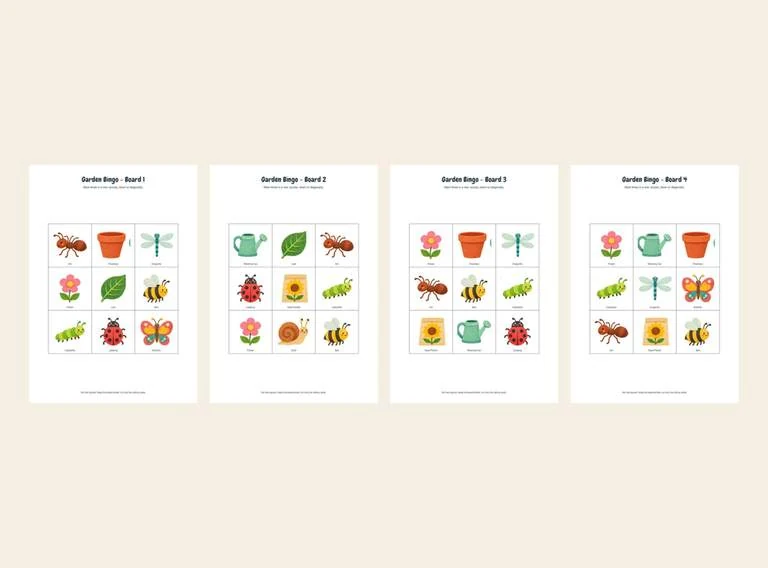
Give each player a different garden board, turn over the calling pictures and look for three in a line. This free picture bingo includes four different three-by-three boards, twelve calling cards and an illustrated guide. Pictures show garden creatures and objects, so the caller can hold up an image as well as saying its name.
Choose Your Download
The complete pack contains 6 pages. Both paper sizes have the same content. Choose the version matching your paper; downloads open directly without an email sign-up.
| File | A4 | US Letter |
|---|---|---|
| Complete pack (6 pages) | A4 PDF | Letter PDF |
| Illustrated guide (1 page) | A4 PDF | Letter PDF |
| Four player boards (4 pages) | A4 PDF | Letter PDF |
| Calling cards (1 page) | A4 PDF | Letter PDF |
Choose Different Player Boards
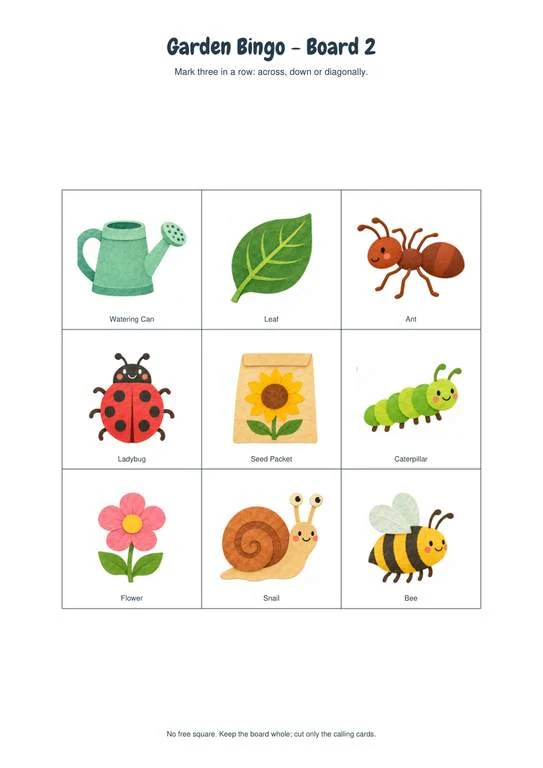
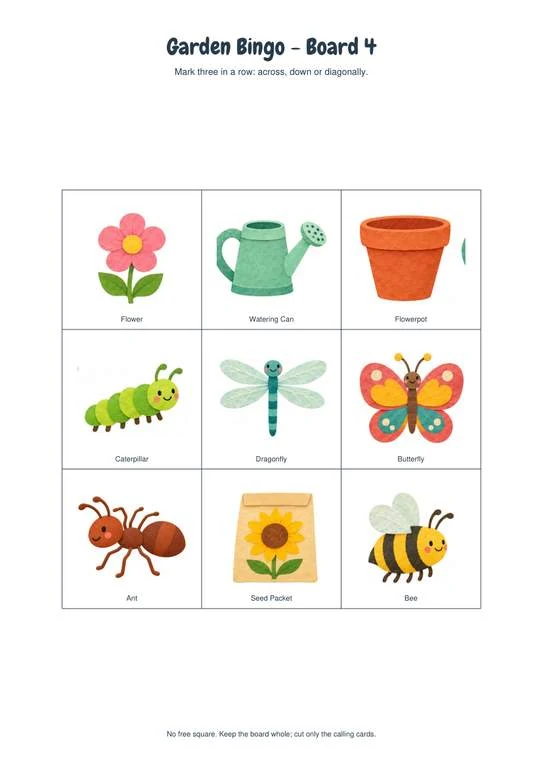
Use the four numbered boards for two to four players plus a caller. Each board contains nine different pictures drawn from the same twelve-picture pool. There is no free center square. A called picture may appear on several boards or be absent from a particular board.
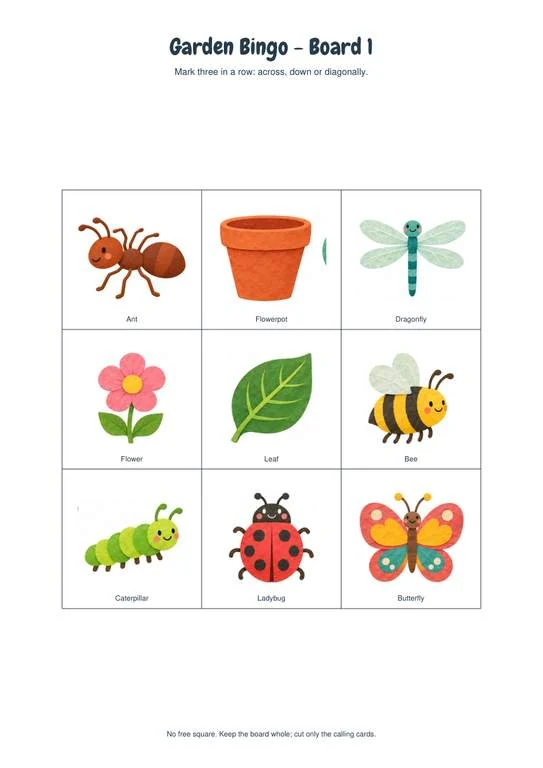
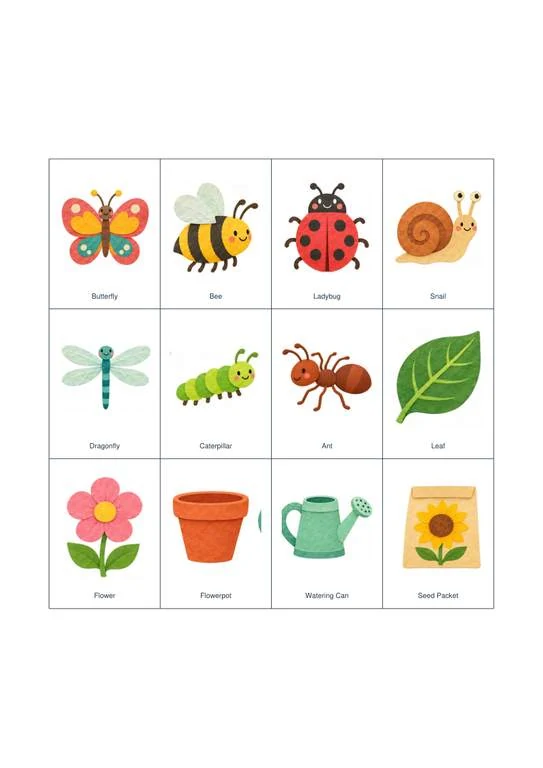
The pool contains butterfly, bee, ladybug, snail, dragonfly, caterpillar, ant, leaf, flower, flowerpot, watering can and seed packet. Printed names help the adult caller agree on a name; children can match the picture without reading the label. Give every player a different board number.
Cut Only the Calling Sheet
Leave the player boards whole. The calling sheet contains twelve cards in one four-column, three-row block, with shared straight cutting edges and no heading or footer to work around. At actual size each calling card is 43 by 58 mm.
Trim around the outside block, then cut the grid. Shuffle all twelve calling cards face down. Pencil marks on the boards are enough to play; an erasable cover and suitable marker are another option if you already use them. No small counters are required.
Call, Match and Mark
The caller turns over one card, shows it clearly and says its name. Players mark that picture if it is on their own board. If it is absent, they wait for the next call. Keep called cards face up in a separate group instead of returning them to the draw pile during the round.
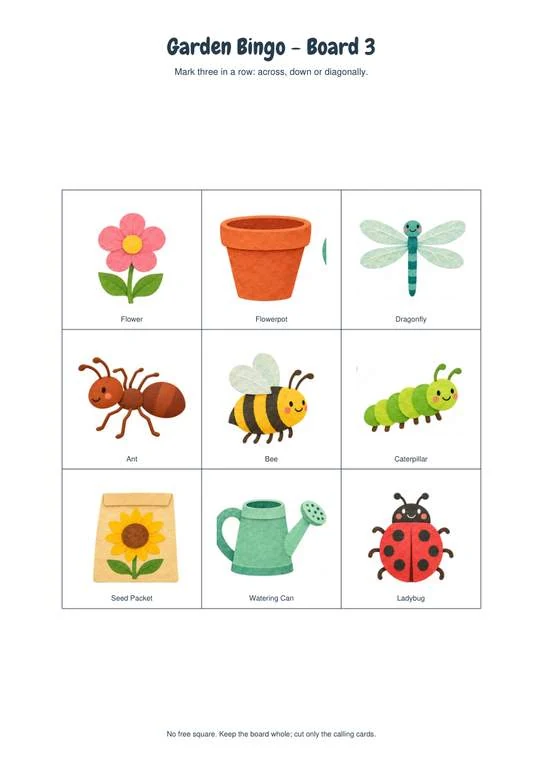
A player calls bingo after marking three pictures in a complete horizontal row, vertical column or diagonal. Check those three pictures against the face-up calling cards. Three scattered marks are not a winning line. More than one player can finish on the same call, and those players can share the win.
Show a Winning Line Before Starting
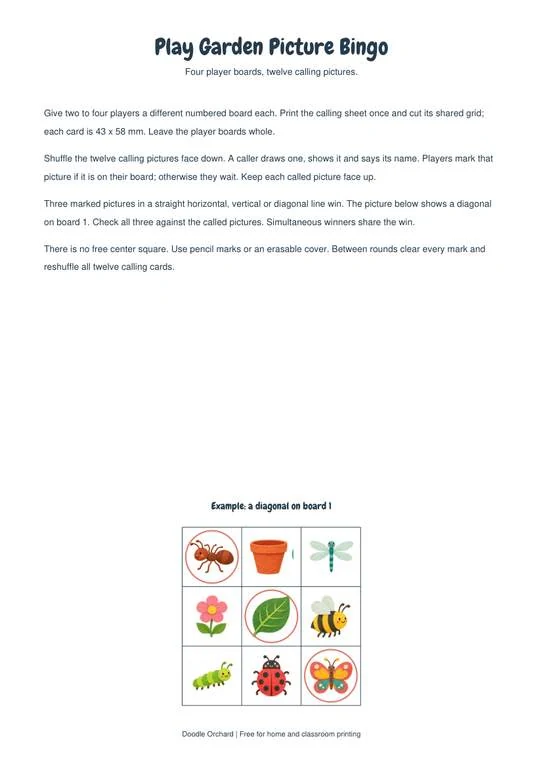
The illustrated guide shows one diagonal on board 1. Point out the two corners and middle square so the rule has a visible example. Then use a clean, unmarked board for the actual game.
For another round, clear every mark and shuffle all twelve calling cards again. More than four players can share boards in pairs, but duplicating a board creates identical play rather than another different board.
Choose What to Print
The complete game has six pages: four boards, one calling sheet and one guide. Separate files let you print only the four boards and calling cards, keeping the guide on a screen. Print one copy of the calling sheet per game group.
Choose matching A4 or US Letter files in portrait orientation. Fit to printable area is fine if all pictures and names are visible. Color artwork is provided; grayscale can be used if the first sheet still shows every picture clearly. The game depends on object identity rather than color alone.
You may print these files for personal, family and classroom activities. Share this resource page with another adult rather than selling or rehosting the PDFs.