
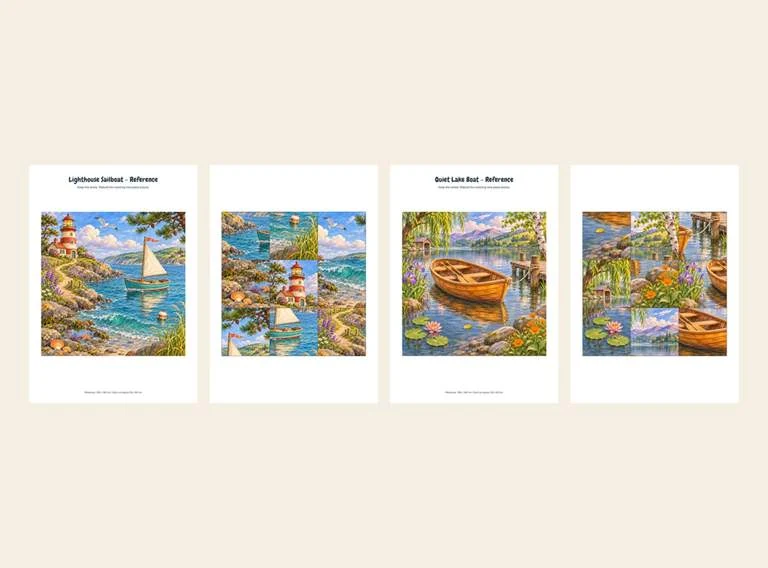
Rebuild two detailed boat pictures from nine square pieces each. This pack has separate mixed cut sheets, complete picture references and a printing-and-play guide in A4 and US Letter. Look at a reference first, then use the pictured details to join one scene at a time.
Choose Your Download
The complete pack contains 5 pages. Both paper sizes include the same content. Downloads open directly without an email sign-up.
| File | A4 | US Letter |
|---|---|---|
| Complete pack (5 pages) | A4 PDF | Letter PDF |
| Cut Sheets (2 pages) | A4 PDF | Letter PDF |
| Whole-picture references (2 pages) | A4 PDF | Letter PDF |
| Printing and play guide (1 page) | A4 PDF | Letter PDF |
Print Matching Files and Prepare One Scene
Choose A4 or US Letter to match your paper. Print the cut sheets and references in the same paper format at 100% / Actual Size, with Fit and Shrink turned off. Each finished picture is 180 × 180 mm, made from nine 60 × 60 mm squares. The complete five-page pack has two mixed cut sheets, two whole-picture references and one guide. Print the complete pack or the separate files, so you do not duplicate them.
An adult trims the outside of each picture block and cuts all its shared straight grid lines. There are no tabs, interlocking edges or gaps between squares. Keep the reference pages whole. Work with one scene’s nine pieces first and leave the second sheet uncut or in its own envelope. Keep the two sets separate; both use the same square shape.
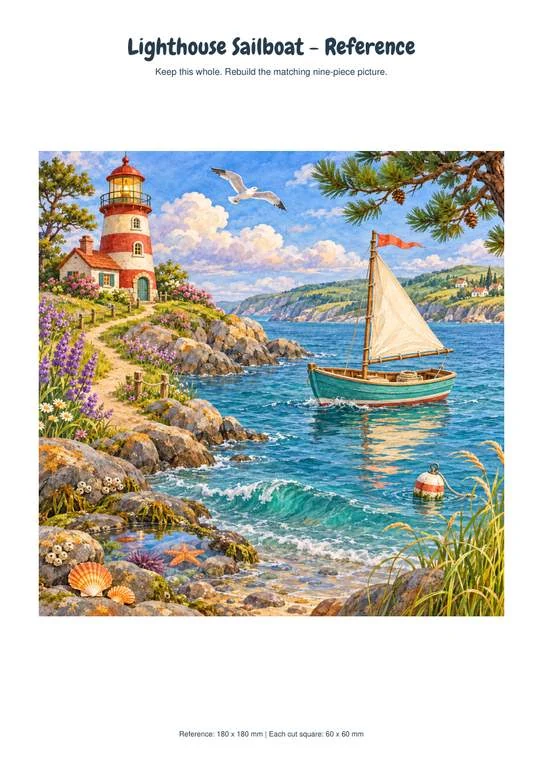
Lighthouse Sailboat Reference
A striped red-and-cream lighthouse rises above a small cottage on the left. A green-hulled sailboat floats on blue water to the right, below a cream sail and red pennant. Purple flowers and a winding path frame the shore; a gull crosses the sky, and a buoy sits near the lower right. Look at the whole picture together before mixing its nine squares. The lighthouse and boat give two distinct places to begin, while the shore and wave lines connect the space between them.
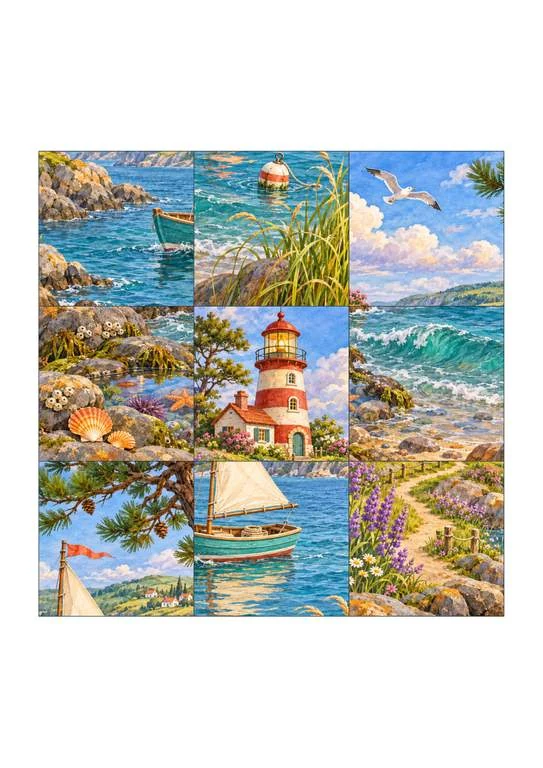
Join the Lighthouse, Sail and Shore
The cut sheet is already shuffled: its printed three-by-three arrangement is not the finished answer. Find the piece with the lighthouse lantern and place it at the upper left of your rebuilt picture. The cream sail continues from the upper-right square down into the middle-right square beside the boat. Match the mast and sail edges across that join, then follow the boat’s hull across the middle row. The buoy and long grasses belong toward the lower right. Keep comparing with the reference instead of trying to make the mixed sheet’s neighbors fit.
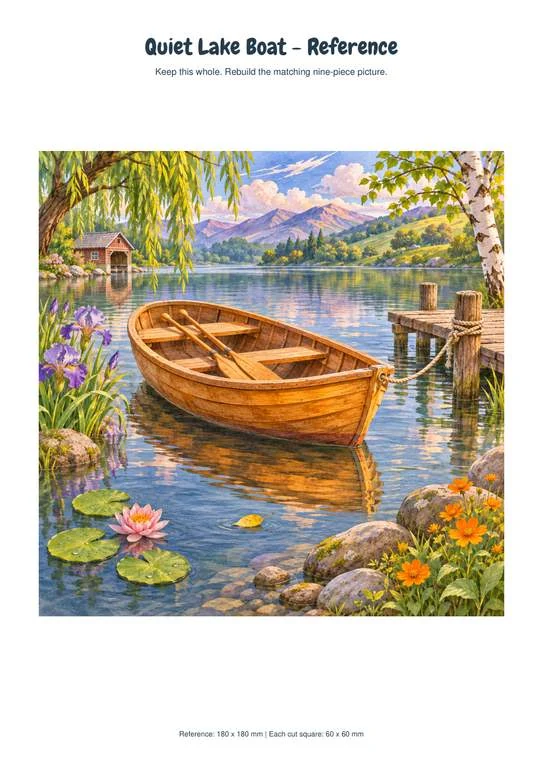
Quiet Lake Boat Reference
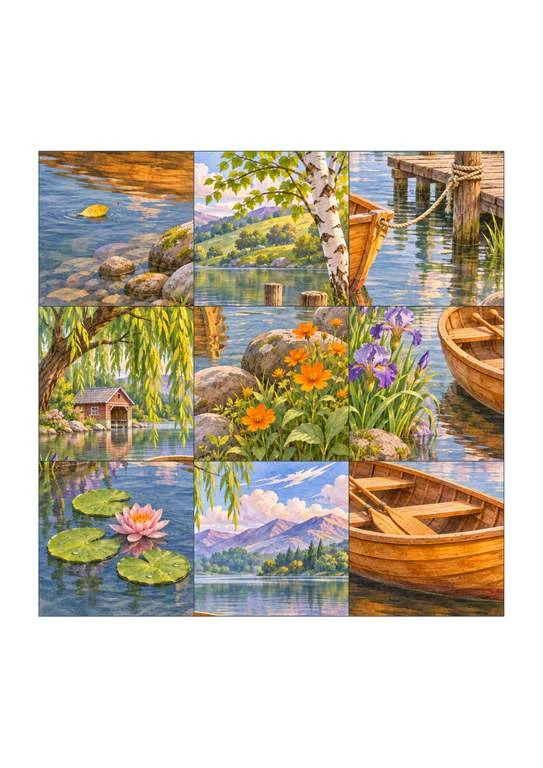
The second picture has a warm wooden rowing boat tied to a dock on the right. A willow bends over the upper left, mountains rise across the far shore and a white birch trunk borders the right. Purple flowers, a pink water lily and orange flowers give the lower corners their own colors. The boat is larger than the lighthouse scene’s sailboat and occupies much of the middle row. Look for the rope leading from the boat toward the dock as one clear connection between neighboring parts.
Follow the Wooden Boat Across Its Squares
The dock-and-rope piece belongs at the middle right, with the boat’s bow joining its wooden middle on the left. The boat’s rounded left end joins its broad wooden middle. Below, the pink lily sits on the left side of the water, while orange flowers and stones fill the lower right. The mountain view goes above the boat. If two watery pieces look similar, compare the direction of a reflection or a shoreline, then check whether a flower stem or rope continues across the shared edge.
Rebuild, Compare and Put Away
Spread one scene’s nine pieces face up on a clear surface beside its reference. Turn the pictures upright and build a three-by-three square. You can begin with a distinctive corner or assemble part of the main object, then add its neighbors. Because every cut edge is straight, use the picture to decide where a piece belongs.
Match lines, outlines and color changes across a shared edge. If a join looks wrong, compare that area with the whole reference and try rotating or moving the square. A single matching color is only a clue. Keep the pieces gently touching so a continuous line can be checked without a gap.
For an easier start, an adult can lay out one completed row and offer the remaining pieces, or find the four corners together. The reference can stay visible throughout. After finishing, compare the complete picture, count all nine squares into their envelope and put that scene away before taking out the other one.
You may print these files for personal, family and classroom activities. Share this resource page rather than selling or rehosting the PDFs.