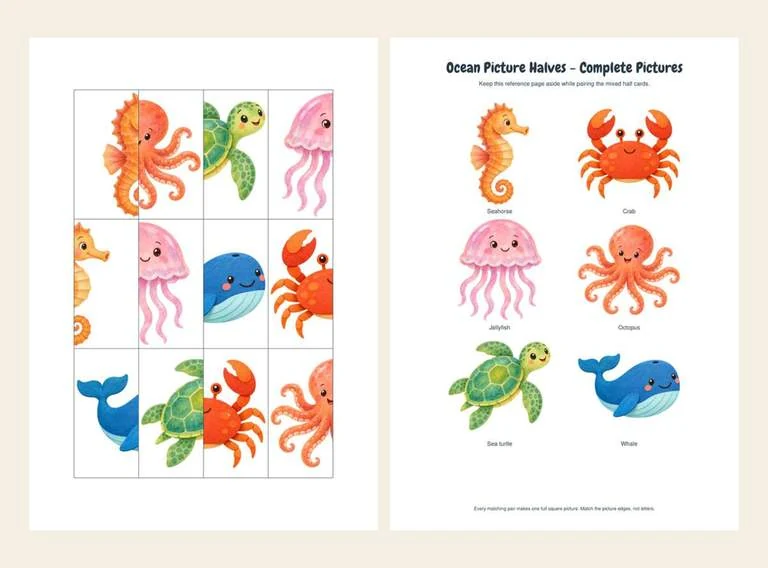
These ocean picture halves turn six colorful illustrations into twelve mixed cards. Find a left half and its matching right half, then join the long edges to rebuild a complete square picture. The pack includes the cut-out sheet, a separate whole-picture answer page and a short guide in both A4 and US Letter.
Choose Your Download
The complete pack contains 3 pages. Both paper sizes include the same content. Downloads open directly without an email sign-up.
| File | A4 | US Letter |
|---|---|---|
| Complete pack (3 pages) | A4 PDF | Letter PDF |
| Cut-out cards (1 page) | A4 PDF | Letter PDF |
| Answers (1 page) | A4 PDF | Letter PDF |
| Printing and play guide (1 page) | A4 PDF | Letter PDF |
The Twelve Mixed Half Cards
The six complete pictures are seahorse, crab, jellyfish, octopus, sea turtle and whale. Each is divided into a left half and a right half, and the twelve pieces are mixed on the printable sheet. A neighboring card on the sheet may belong to a different picture.
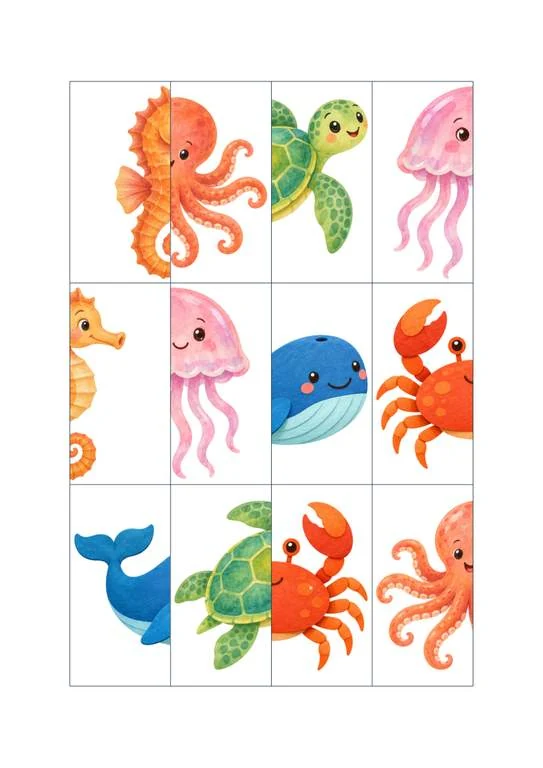
The card fronts have no title, footer or answer letters. Children can concentrate on the actual picture edges. Notice the sea turtle's patterned green shell; details like these provide a more precise clue than choosing two pieces simply because they have similar colors.
Print and Cut Along the Grid
Select the PDF for the paper you are loading: A4 or US Letter. Print the cards sheet single-sided, in portrait orientation, at actual size or 100%. Turn off fit-to-page resizing if you want to keep the stated dimensions. Color printing preserves the details used in the matching game.
An adult trims the outside rectangle and cuts every shared straight grid line. There are four columns and three rows, making twelve 39 x 78 mm half cards. Two matching halves placed side by side make a 78 x 78 mm square. There are no gaps to trim between cards and no backs to prepare. Keep the whole-picture sheet uncut.
Build One Complete Picture
Spread the cards face up on a clear table. Choose a half with a recognizable detail, then search for the missing side of that same object. Put the proposed pair upright next to each other, with the two long inner edges touching. The outside edges should make one square.
Follow the outline, colors and marks across the join. For example, compare the orange crab and octopus: both have spreading limbs, but their faces, body edges and colors must continue across the center. If the center has a sudden jump or a feature stops without its continuation, try another partner.
Do not overlap the cards to hide a mismatch, and do not rotate one to manufacture a join. The intended pictures all use one upright left side and one upright right side. Once a pair is complete, move it above the loose cards and choose the next half.
Use the Whole-Picture Answers
The separate answer page shows all six intact pictures: seahorse, crab, jellyfish, octopus, sea turtle and whale. It gives a full-image reference rather than letters to match. Compare a completed pair with its whole picture, checking the center join as well as the overall silhouette.
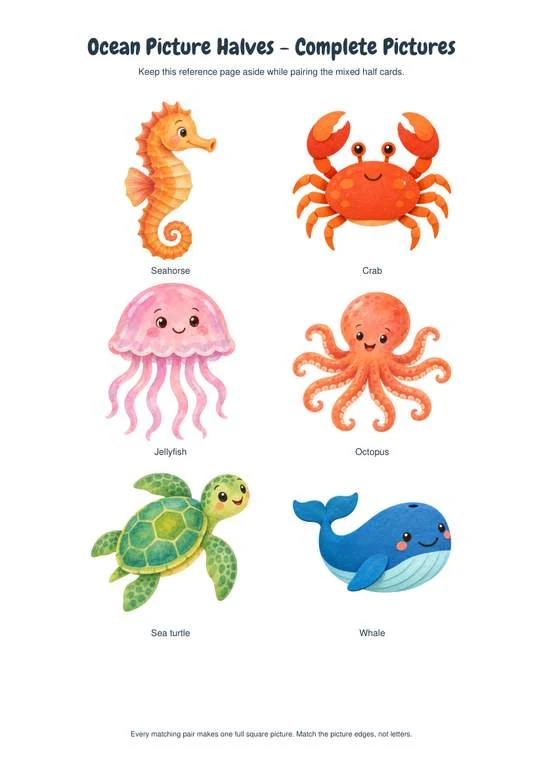
Keep the page visible if a child wants a model, or put it aside for a more independent round. If a pair is difficult, point to one feature in the whole picture, then find the two cards that show its continuation. A finished square should have the same complete object as the reference.
Start with Two Pairs, Then Add More
For a small first game, an adult uses the whole-picture page to pick two complete pairs. Offer those four cards face up, leaving the other eight aside. Choosing arbitrary four cards can leave a child with a half whose partner is missing.
Build one picture together, then let the child try the second. Add a complete pair at a time when more choice is welcome. For two players, take turns choosing a starting half and asking the other player to find its partner. Keep all offered cards face up so the activity stays about picture joins.
Mix Again and Store the Set
When all six squares are complete, count the twelve cards before mixing them for another round. You can deliberately swap two halves for a silly-picture moment, describe what changed, and then restore the correct pictures with the answer page. Keep that playful variation separate from checking the actual pairs.
Store the twelve cards in an envelope with the resource name on it, and keep the answer page and guide folded or filed alongside it. Before the next game, check that every picture has both halves. If a piece is lost, print the cards sheet again in the same paper size at 100% and replace the missing pair together.
You may print these files for personal, family and classroom activities. Share this resource page rather than selling or rehosting the PDFs.