
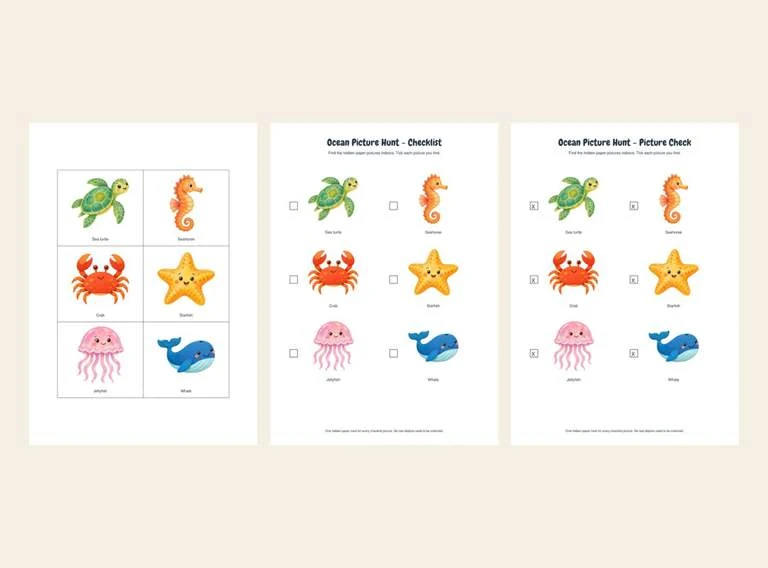
Turn a familiar indoor space into an ocean picture hunt with six printable cards and a matching tick-box checklist. The pictures are sea turtle, seahorse, crab, starfish, jellyfish and whale. An adult places the paper cards around the play area, then children find and mark them. You can move the same cards for a new round without changing the rules.
Choose Your Download
The complete pack contains 4 pages. Both paper sizes include the same content. Downloads open directly without an email sign-up.
| File | A4 | US Letter |
|---|---|---|
| Complete pack (4 pages) | A4 PDF | Letter PDF |
| Cut-out cards (1 page) | A4 PDF | Letter PDF |
| Checklist (1 page) | A4 PDF | Letter PDF |
| Answers (1 page) | A4 PDF | Letter PDF |
| Printing and play guide (1 page) | A4 PDF | Letter PDF |
Meet the Six Picture Cards
The cut-out sheet contains sea turtle, seahorse, crab, starfish, jellyfish and whale. Compare the long orange seahorse with the broad blue whale, or the pink jellyfish with the orange crab. Ask for the whole pictured animal: finding a blue toy does not count as finding the whale card.
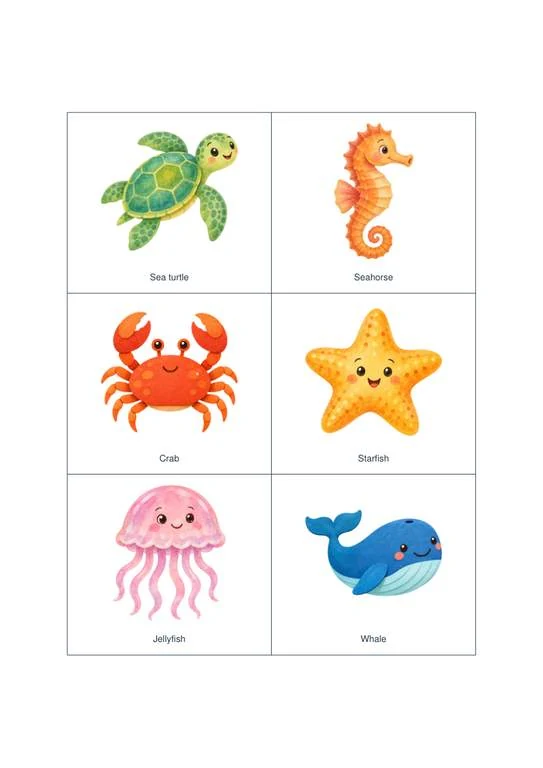
There is one of each picture to hide. Before cutting or hiding anything, look over all six together so the children know what they are looking for. The words under the pictures can help an adult name them, while the illustrations let a child follow the game by matching pictures.
Print and Cut the Cards
Use the A4 PDF with A4 paper or the US Letter PDF with Letter paper. Select portrait, single-sided printing and actual size or 100%. Print the cards in color for the pictured colors to remain useful. At this scale each card measures 79 x 70 mm in either paper format.
An adult trims around the outside rectangle, then cuts along the shared straight grid lines to make six separate cards. Cut the rectangles, rather than cutting around the animals or objects themselves. No separate backs or glue are required. Keep the checklist whole. Print one checklist per child for individual searches, or one shared checklist for a cooperative round.
Use the Matching Checklist
The checklist repeats all six card pictures with an empty box beside each one. Give the child a pencil and explain that a tick means that particular paper picture has been found.
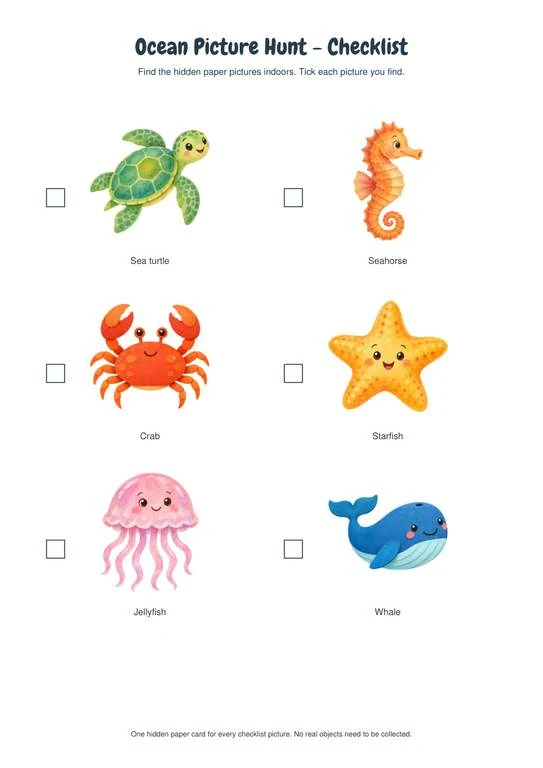
Demonstrate with one card before hiding the set: find its matching illustration on the checklist and point to its box. A child who would rather point can show the picture while an adult makes the tick. Leave the separate picture-check sheet with its completed boxes aside until the end.
Choose the Search Area
Pick one familiar indoor area and explain its boundary before starting: for example, this room and the reachable furniture inside it. Place cards at an easy-to-reach height, away from stairs, water, hot surfaces, sockets and breakable objects. The game should not require climbing or opening cupboards.
For example, put the whale on a low bookshelf and the seahorse against a cushion on a chair. Keep enough of each picture showing to recognize it. The game can have an ocean theme without any water or real shells.
For the first round, place all six cards in plain sight. You can make a later round a little less obvious by partly hiding a card while keeping enough visible to spot it. Keep your own short note of the six locations if you might forget one.
Play a Complete Round
Walk through the agreed area looking for the paper pictures. When a child finds one, pause and tick the matching illustration on the checklist. If several children are searching, leave the card in place so everyone can find it. For one child, bringing the card back to an adult is another simple option. Decide which version you are using before the search.
Continue until all six boxes are ticked. If one remains empty, name its picture together and give a location clue such as "look beside the books" rather than revealing every hiding place. An easier short round can use three chosen cards; agree which three checklist pictures count before starting.
Check the Pictures and Reset
The picture-check page shows the same six illustrations with completed boxes. It is an inventory of what to find, rather than a map of hiding places: the adult chooses those each round. Compare every tick with a found card so an accidental double tick does not conceal a missing picture.
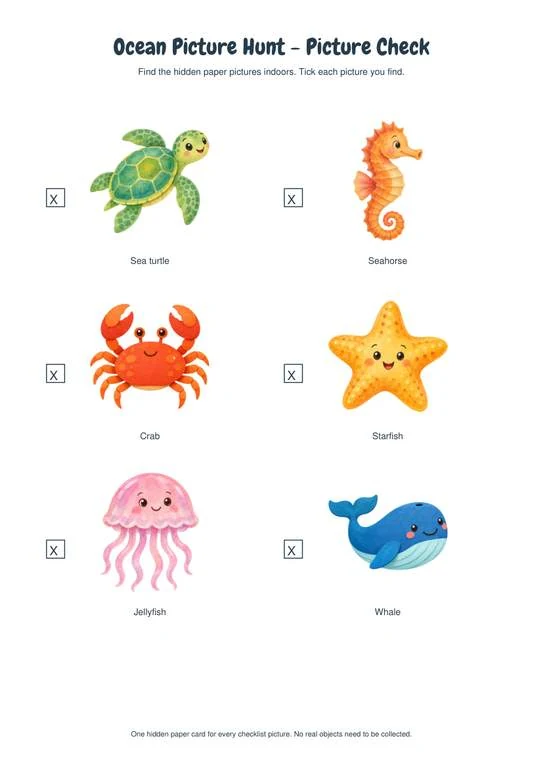
Count all six cards back in before packing away. Store them with the whole checklist and guide in a labeled envelope or folder. For another game, erase the pencil ticks or print a fresh checklist and move the cards. You can also let a child help choose the next reachable hiding spots while an adult checks the area.
You may print these files for personal, family and classroom activities. Share this resource page rather than selling or rehosting the PDFs.