
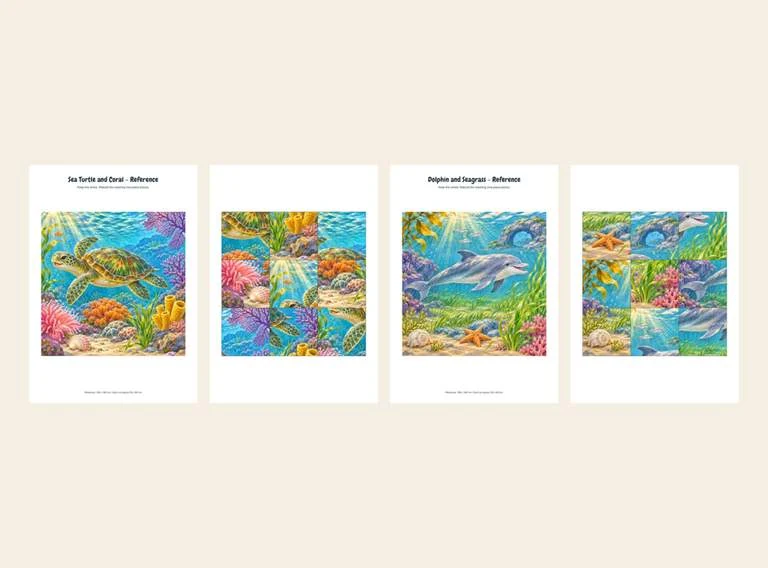
Rebuild two detailed ocean pictures from nine square pieces each. This pack has separate mixed cut sheets, complete picture references and a printing-and-play guide in A4 and US Letter. Look at a reference first, then use the pictured details to join one scene at a time.
Choose Your Download
The complete pack contains 5 pages. Both paper sizes include the same content. Downloads open directly without an email sign-up.
| File | A4 | US Letter |
|---|---|---|
| Complete pack (5 pages) | A4 PDF | Letter PDF |
| Cut Sheets (2 pages) | A4 PDF | Letter PDF |
| Whole-picture references (2 pages) | A4 PDF | Letter PDF |
| Printing and play guide (1 page) | A4 PDF | Letter PDF |
Print Matching Files and Prepare One Scene
Choose A4 or US Letter to match your paper. Print the cut sheets and references in the same paper format at 100% / Actual Size, with Fit and Shrink turned off. Each finished picture is 180 × 180 mm, made from nine 60 × 60 mm squares. The complete five-page pack has two mixed cut sheets, two whole-picture references and one guide. Print the complete pack or the separate files, so you do not duplicate them.
An adult trims the outside of each picture block and cuts all its shared straight grid lines. There are no tabs, interlocking edges or gaps between squares. Keep the reference pages whole. Work with one scene’s nine pieces first and leave the second sheet uncut or in its own envelope. Keep the two sets separate; both use the same square shape.
Sea Turtle and Coral Reference
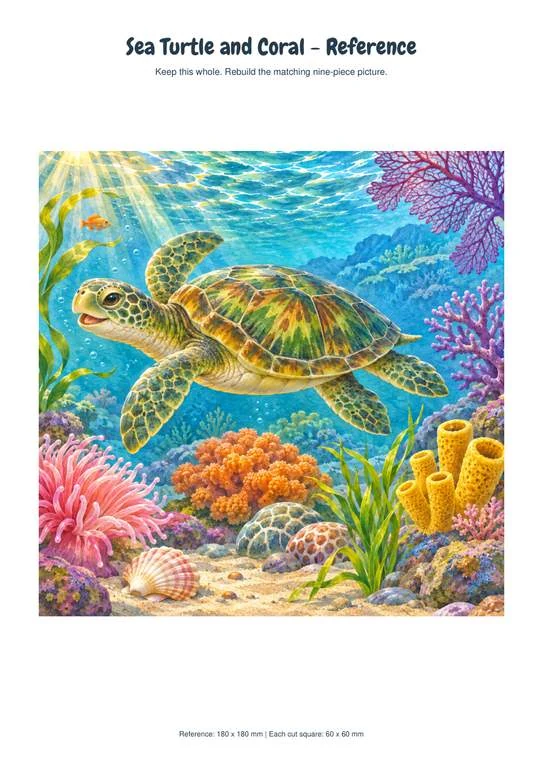
A green-and-gold sea turtle swims toward the left through blue water. Sunbeams enter from the upper left, with purple branching coral on the right. Pink anemone-like shapes and a shell anchor the lower left; yellow tube sponges stand near the lower right. The turtle’s patterned shell provides a large central landmark, while the different corners help place the surrounding squares. Look at where the head, flippers and shell sit in the whole reference before trying the mixed pieces.
Continue the Shell and Flipper Outlines
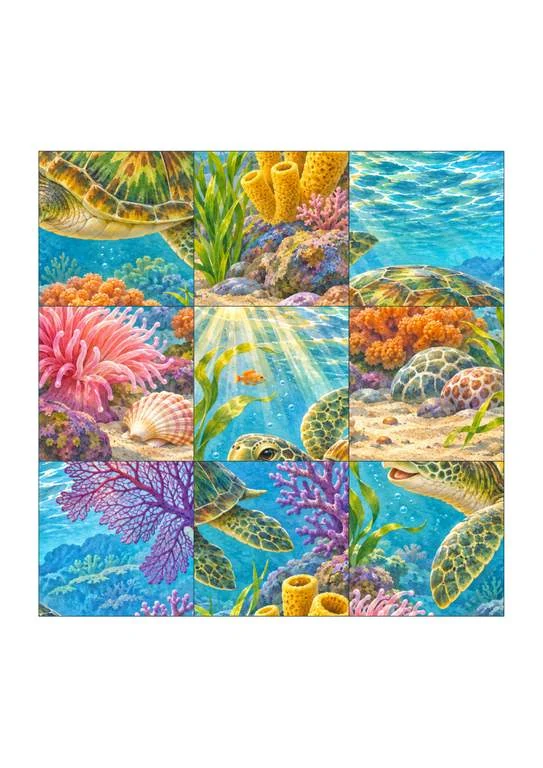
The turtle’s head belongs in the middle-left square and its shell continues through the center toward the right. Match the shell’s curved rim across neighboring edges, then follow the flipper outlines below the shell. Keep the rays of light at the upper left and the yellow tube sponges toward the lower right. A purple coral fragment can help identify a right-hand piece. When two blue areas seem interchangeable, compare the fine seaweed or coral branches at their edges rather than using water color alone.
Dolphin and Seagrass Reference
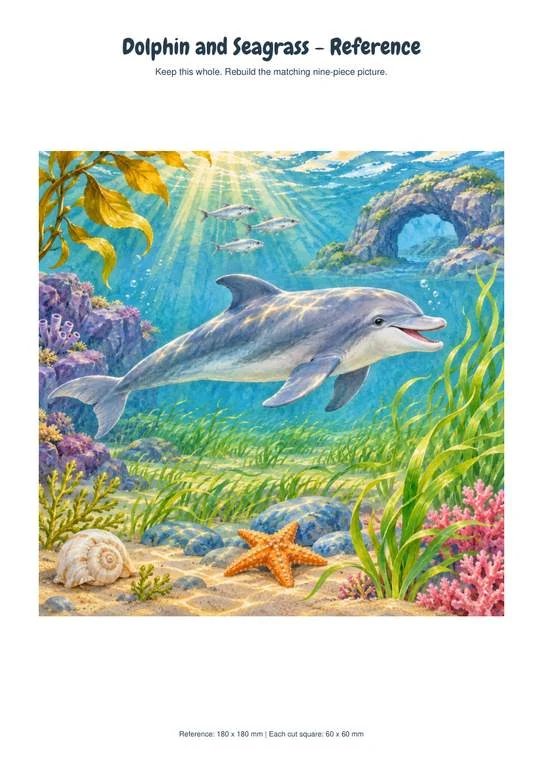
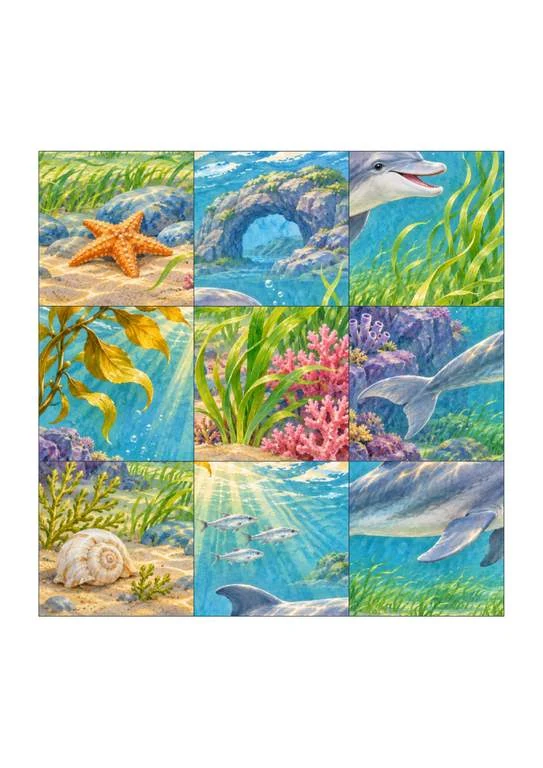
A gray dolphin faces right above a sandy seabed. Small silver fish swim near the sunbeams at the top; a rock arch lies in the upper right. Tall seagrass rises along the right edge, and a spiral shell and orange starfish sit near the bottom. Unlike the turtle’s round shell, the dolphin forms a long diagonal body through the center. Find its face and tail on the reference first, then notice the curve that joins them.
Join the Dolphin from Tail to Face
Look for the square with the dolphin’s face and place it toward the middle right. The broad body continues leftward through the center, with the tail farther left. Check the back and belly outlines across those joins. The rock arch is a top-right landmark, and the spiral shell sits at the lower left. Orange starfish and pale sand help orient the bottom-middle piece. If a grass-filled square seems uncertain, compare the stems across both its top and side edges and use the complete picture to settle its position.
Rebuild, Compare and Put Away
Spread one scene’s nine pieces face up on a clear surface beside its reference. Turn the pictures upright and build a three-by-three square. You can begin with a distinctive corner or assemble part of the main object, then add its neighbors. Because every cut edge is straight, use the picture to decide where a piece belongs.
Match lines, outlines and color changes across a shared edge. If a join looks wrong, compare that area with the whole reference and try rotating or moving the square. A single matching color is only a clue. Keep the pieces gently touching so a continuous line can be checked without a gap.
For an easier start, an adult can lay out one completed row and offer the remaining pieces, or find the four corners together. The reference can stay visible throughout. After finishing, compare the complete picture, count all nine squares into their envelope and put that scene away before taking out the other one.
You may print these files for personal, family and classroom activities. Share this resource page rather than selling or rehosting the PDFs.